
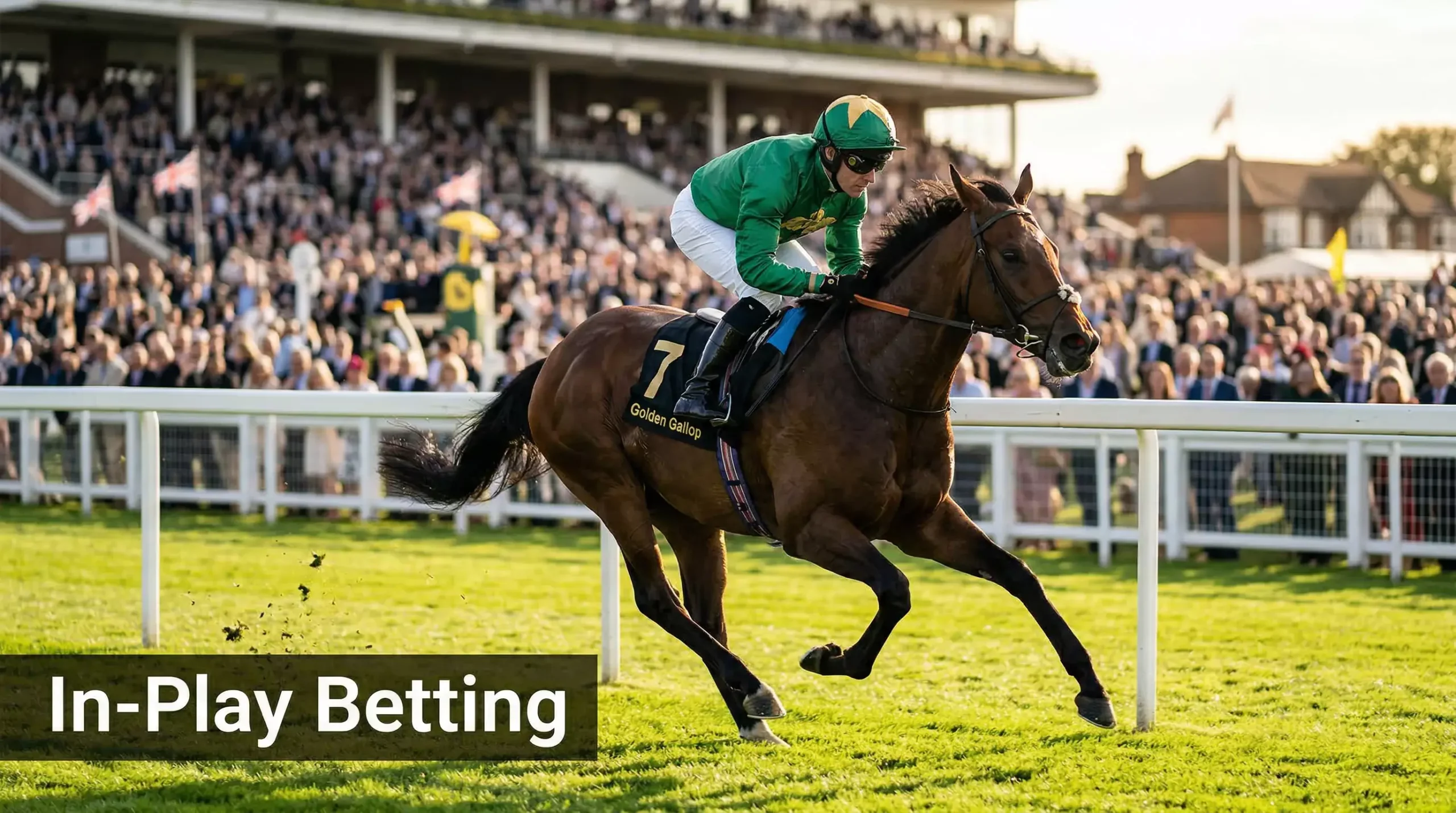
In-play horse racing betting begins the moment horses leave the starting gates. Unlike pre-race wagering, where you commit your stake hours or minutes before the off, in-play betting lets you react to what you see unfolding on the track. The favourite stumbles at the first furlong. A backmarker suddenly finds another gear rounding the final bend. These moments create opportunities that simply do not exist when markets close at the start.
The growth of real-time wagering reflects a broader shift in how punters engage with racing. According to Houlihan Lokey’s European Online Gaming Market Report, real event online betting generated £2.3 billion in gross gaming yield during 2024, representing a 15% year-on-year increase. That figure encompasses football, tennis, and other sports, but horse racing remains a significant contributor to the in-play market. The appeal is straightforward: you can assess a horse’s condition, the pace of the race, and the jockey’s tactics before committing your money.
“There is undoubtedly an ever-growing desire for data among those consuming and betting on racing,” notes Brant Dunshea, Acting CEO of the British Horseracing Authority. “As other sports continue to develop ways in which their fans can gain greater insights through use of real-time data, this is clearly an area in which racing can continue to evolve.” That evolution is already underway. Bookmakers now offer live streaming integrated with in-play markets, giving punters the visual information they need to make split-second decisions.
This guide covers the mechanics of in-play betting, from how markets open to why odds shift mid-race. It examines timing strategies that separate impulsive punts from calculated wagers, explores the mobile platforms where most live betting now occurs, and addresses the risk management essential for anyone betting in real time. In-play horse racing betting rewards those who understand both the sport and the market dynamics. Without that understanding, you are simply gambling on chaos.
In-Play Mechanics Explained
When Markets Open In-Running
Most bookmakers suspend betting approximately 30 seconds before a race starts, then reopen markets once the horses are running. This brief suspension allows operators to recalibrate their positions based on final market movements. When the in-play market opens, prices reflect the pre-race state adjusted for any early developments. A horse that breaks slowly will immediately lengthen in price, while a clean-starting favourite might tighten.
The exact moment markets reopen varies between operators. Some bookmakers, particularly those offering exchange betting, open in-running markets almost instantly after the off. Traditional fixed-odds operators tend to be more cautious, waiting until the field has settled into a running order. This difference matters if you plan to trade positions between platforms or exploit price discrepancies in the opening seconds of a race.
Flat races generally offer shorter in-play windows than National Hunt contests. A five-furlong sprint might provide only 55 to 60 seconds of live betting opportunity, while a four-mile chase at Cheltenham could extend that window to eight minutes or more. The longer the race, the more opportunity you have to read its development and identify value.
How Bookmakers Set Live Odds
In-play odds derive from algorithmic models that process multiple inputs: current position, distance remaining, historical performance of similar race patterns, and the behaviour of other bettors. When money floods onto a particular horse mid-race, the price shortens regardless of what is happening on the track. This creates a tension between market-driven odds and race-driven reality.
The algorithms running these markets have become increasingly sophisticated. Early in-play systems relied heavily on position data, which created exploitable patterns. Punters who could process visual information faster than the models could find value before prices adjusted. Modern systems incorporate stride analysis, sectional timing data, and machine learning trained on thousands of race outcomes. They are harder to beat than they used to be.
Bookmakers also build in larger margins during in-play trading compared to pre-race markets. The overround on a live market might be 15% or higher, compared to 5% or less for the same race before the off. This margin compensates operators for the increased risk of trading during rapidly changing conditions.
Exchange vs Fixed-Odds In-Play
Betting exchanges handle in-play differently from traditional bookmakers. On an exchange, you are betting against other punters rather than the house. Liquidity can be thinner than pre-race, particularly in smaller races, but the absence of a bookmaker margin means better prices when you can find a match.
Exchange in-play betting also allows you to lay horses, effectively betting on them to lose. This opens strategic possibilities unavailable with fixed-odds bookmakers. You might back a horse pre-race at 6.0, then lay it in-running at 3.0 to lock in a profit regardless of the result. This trading approach requires quick reactions and reliable connectivity, but it transforms in-play betting from simple punting into something closer to financial trading.
The delay between placing a bet and it being accepted creates additional complexity on exchanges. During in-play, this delay can stretch to several seconds, during which the market may have moved against you. Many experienced in-play traders use software that accounts for these delays and adjusts their stakes accordingly.
Understanding Odds Movement
Reading Price Shifts
Odds during a race communicate information. When a horse’s price shortens from 5.0 to 3.5 with two furlongs remaining, the market is saying that horse’s winning probability has increased substantially. The question is whether the market is right or whether you can read the race better than the algorithm.
The Houlihan Lokey report noted that active betting accounts grew by 3% in 2024, while the total number of bets placed increased by 9% year-on-year. This disparity suggests that existing punters are betting more frequently, likely driven by the accessibility of in-play markets on mobile devices. More bets mean more price movements, which creates both noise and opportunity.
Position-based price shifts are the most common pattern. A horse that moves from fifth to second will shorten, while one dropping from second to sixth will drift. These movements are mechanical and predictable. The more interesting shifts occur when prices move against positional logic: a horse maintaining its place but still drifting, perhaps because experienced watchers have noticed a change in its action or a jockey starting to push earlier than expected.
What Causes Dramatic Swings
Sharp price movements usually have identifiable triggers. A mistake at a fence in a National Hunt race will cause an immediate lengthening. A horse being pulled up or falling removes it from the market entirely, causing all remaining prices to shorten proportionally. These reactive movements happen within seconds of the triggering event.
Interference and bumping create temporary chaos in odds. When two horses clash mid-race, their prices might swing wildly as algorithms struggle to assess the damage. Experienced in-play bettors watch for overreactions here. A horse that loses a length to interference but recovers its momentum might represent value if the market has overcorrected.
Pace-related swings are subtler but equally important. A front-runner setting too fast a pace will often drift in the final stages as the market anticipates it fading. Closers, by contrast, typically shorten progressively as they work through the field. Understanding a horse’s running style helps you anticipate these movements rather than react to them.
Finding Value in Movement
Value in-play betting is not about predicting winners. It is about identifying moments when the market price does not accurately reflect a horse’s actual chance. A horse priced at 4.0 with what you assess as a 30% chance of winning represents value. The same horse at 2.5 does not.
The fastest money in horse racing in-play comes from spotting mistakes. Not your mistakes, but the market’s. When a horse stumbles and its price drifts from 3.0 to 8.0, the question is whether that stumble genuinely reduced its chance by that proportion. If the horse recovered quickly and is still travelling well, the 8.0 might represent value that the market will correct within seconds.
Sectional timing, where available, provides objective data to support visual assessment. If a horse has recorded faster sectional times than its rivals despite appearing to travel within itself, that is information the basic position-based algorithms might not fully incorporate. Racing data providers now offer real-time sectionals at major fixtures, giving data-oriented punters another edge. Translating that edge into profit, however, depends on knowing when to act.
Timing Strategies for Live Bets
Early Race Opportunities
The opening furlongs of a race offer specific opportunities. Horses that break slowly but have strong closing records often drift to prices that overstate their chances of losing. If you know a horse’s preferred running style is to come from behind, a poor start might actually be irrelevant to the outcome. The market does not always make that distinction.
Early pace reads are particularly valuable in National Hunt racing, where races unfold over longer distances. A muddling early pace benefits front-runners by allowing them to conserve energy. A fierce early gallop favours closers by ensuring the leaders tire. Within the first half-mile, you can often assess which scenario is developing and position accordingly.
The British Horseracing Authority’s Racing Report noted that the percentage of race clashes on Saturdays dropped from 11.1% in 2022 to 5.8% in 2024. This improvement in scheduling means punters can now watch more races live without conflicts, enhancing the quality of information available for in-play decisions. When you can actually see the race rather than relying on data feeds, your edge increases.
Mid-Race Decision Points
The middle portion of a race is where most value materialises. Initial positions have stabilised, early pace has established itself, and jockeys are starting to make tactical decisions. This is when watching replays pays off. If you have seen how a particular horse responds when asked for an effort at this stage of similar races, you have information the algorithms lack.
Turning for home marks a critical decision point in most races. Horses on the bridle at this stage have their chances intact. Those already under pressure are fighting a losing battle in most cases. The transition from travelling to being pushed is often visible before it fully registers in the market.
Position through the field becomes increasingly important in the middle stages. A horse boxed in behind a wall of rivals faces a fundamentally different challenge than one with clear running. Markets do account for this, but often imprecisely. Watching for horses angled out to make their challenges can give you a head start on the algorithmic adjustment.
Final Furlong Betting
The closing stages of a race offer the least value for in-play betting in terms of edge, but they remain popular because outcomes become visible. A horse leading by two lengths with 100 yards to run is heavily odds-on, but there is limited profit potential unless you backed it earlier at longer prices.
Where final furlong betting retains some edge is in evaluating staying power. Horses coming under pressure earlier than expected often fade dramatically in the final strides. Those still travelling comfortably can maintain their advantage or accelerate past tiring rivals. The difference between a horse under a hard ride and one being pushed along gently is often more significant than the margin between them on the track.
Laying horses in the final furlong carries its own risks. A two-length leader might appear to be stopping, but it might just be reducing its effort with the race won. Experienced jockeys often ease up when victory is secured, which can create the visual impression of a horse being caught. The market sometimes panics in these situations, offering value on the leader to punters who recognise the jockey’s confidence.
Mobile In-Play Betting
Best Apps for Live Racing
In-play betting has migrated decisively to mobile devices. Data from the Gambling Commission indicates that mobile accounts for over 70% of all online gambling activity. For in-play racing specifically, that proportion is likely even higher, given the need to bet while watching races away from desktop computers.
The major UK bookmakers all offer dedicated apps with in-play functionality. Bet365’s interface remains the benchmark for in-play racing, with integrated streaming, one-touch betting, and real-time odds updates. William Hill and Ladbrokes have improved substantially in recent years, while Betfair’s exchange app offers the trading functionality that serious in-play punters require.
App design matters more for in-play betting than for pre-race wagering. You need to place bets quickly, often while watching streaming video on the same screen. Apps that require multiple taps to navigate from the racecard to the bet slip create friction that can cost you valuable seconds. Testing multiple apps on non-critical races before committing to one for serious in-play betting is time well spent.
Connection Requirements
In-play betting is only as reliable as your connection. A bet placed on a horse at 5.0 means nothing if network latency causes it to be accepted at 3.0 after the market has moved. Mobile data connections vary enormously in speed and consistency, particularly at racecourses where thousands of punters are competing for bandwidth.
4G coverage at British racecourses is generally acceptable for in-play betting, though you may experience congestion on major race days. Festival meetings at Cheltenham, Ascot, and Aintree are notorious for network overload. If you plan to bet in-play from the course during these events, arriving early to test your connection and identifying areas with stronger signal is sensible preparation.
Home connections offer more reliability but introduce their own issues. Wi-Fi routers positioned far from where you watch racing can create latency problems. A wired ethernet connection to a laptop provides the most consistent experience for serious in-play bettors, though this obviously limits mobility.
Quick Bet Features
Modern betting apps include features designed specifically for in-play scenarios. One-click betting allows you to place a bet at the current price without confirming, reducing the time between decision and execution. This speed comes with risks: accidental bets become more likely, and the absence of a confirmation step removes your final opportunity to reconsider.
Preset stake functionality lets you configure default bet amounts for different types of wager. Setting separate defaults for in-play bets, typically smaller than pre-race stakes to account for the higher variance and faster action, helps maintain discipline when decisions need to be made quickly.
Cash out and partial cash out features integrate with in-play betting, allowing you to secure profits or limit losses mid-race. The prices offered on cash outs are generally less favourable than what you could achieve by placing an opposing bet manually, but the convenience factor is significant when you need to react in seconds rather than minutes.
Risk Management in Real-Time
Stake Sizing for In-Play
The concentration of betting revenue tells you something important about in-play risk. Research published by the National Centre for Social Research found that the top 1% of horse racing bettors, approximately 60,000 people, generate 52% of racing betting revenue. These high-volume punters are disproportionately active in in-play markets, where the pace of betting allows rapid turnover of stakes. They are also, notably, the most susceptible to affordability checks introduced by regulators.
For the typical punter, in-play stakes should be smaller than pre-race stakes. The reasoning is straightforward: in-play betting involves more decisions, faster decisions, and less time for each decision. Reducing stake size compensates for the increased likelihood of errors. A standard approach is to halve your typical pre-race stake for in-play wagers, adjusting upward only when you have identified clear edge situations.
Absolute loss limits per race, per session, and per day provide guardrails that matter more in in-play betting than in pre-race scenarios. The speed of action makes it easy to lose track of cumulative exposure. Setting these limits before you start and stopping when you reach them is the only reliable way to prevent sessions running away from you.
Avoiding Emotional Chasing
In-play betting creates emotional pressure that pre-race betting does not. Watching a race unfold while your money is at stake produces visceral reactions that can override rational decision-making. When your backed horse loses by a nose, the temptation to immediately recoup that loss on the next race is powerful. This is when discipline matters most.
The structure of racing cards compounds the problem. Races run approximately every 15 to 20 minutes on busy days, sometimes across multiple meetings simultaneously. There is always another opportunity, which makes stepping away harder than it should be. Building in mandatory breaks after losses, particularly significant ones, interrupts the emotional cycle that leads to chasing.
Reviewing your in-play betting history periodically reveals patterns you might not notice in real time. Many punters discover that their worst losses come in the final races of a session, when fatigue and accumulated frustration combine to produce poor decisions. If your data shows this pattern, ending sessions earlier is the logical response, even if it means missing potential winners.
Cash Out Decisions
Cash out functionality has transformed how punters manage in-play positions. The ability to secure a profit before the race concludes, or to salvage something from a losing position, adds a dimension of control that did not exist a decade ago. But that control is illusory if you do not use it systematically.
The mathematics of cash out offers reveal how bookmakers profit from the feature. Cash out prices typically include a margin of 5% to 10% compared to the fair value of your position. You pay for the convenience. This does not mean you should never cash out, but it does mean you should have clear criteria for when the cost is justified.
Pre-committing to cash out conditions before the race starts removes emotion from the decision. If you decide in advance that you will cash out at 50% profit or 75% loss, you simply execute that plan without second-guessing. The alternative, making cash out decisions in real time while watching your horse compete, invites precisely the kind of emotional reasoning that leads to poor outcomes.
Making In-Play Work for You
In-play horse racing betting rewards preparation, patience, and discipline. The punters who profit consistently are not those with the fastest fingers or the best luck. They are the ones who understand how markets function, who can read a race while it unfolds, and who maintain emotional control when money is on the line.
Start with small stakes and clear rules. Learn the rhythms of in-play markets on races where you have no financial interest. Identify the specific situations where you believe you have an edge, whether that is reading early pace, spotting horses with superior stamina, or recognising when the market has overreacted to a mistake. Then test those theories systematically, keeping records that allow you to evaluate your actual performance rather than your remembered highlights.
The technology that enables in-play betting continues to evolve. Live streaming quality improves each season. Sectional timing becomes more widely available. Algorithmic odds models grow more sophisticated. These developments make it harder to find edges but also create new opportunities for those willing to develop specialised knowledge. The punters who treat in-play betting as a skill to be developed, rather than a game of chance to be played, will continue to find value in the markets.
Risk management deserves the final word. No strategy, no matter how well-researched, eliminates variance. Losing runs happen to every in-play bettor. The difference between those who survive them and those who do not lies in stake sizing, loss limits, and the ability to step away when conditions require it. In-play betting offers genuine opportunities, but only to those who approach it with the respect it demands.