
 Available in US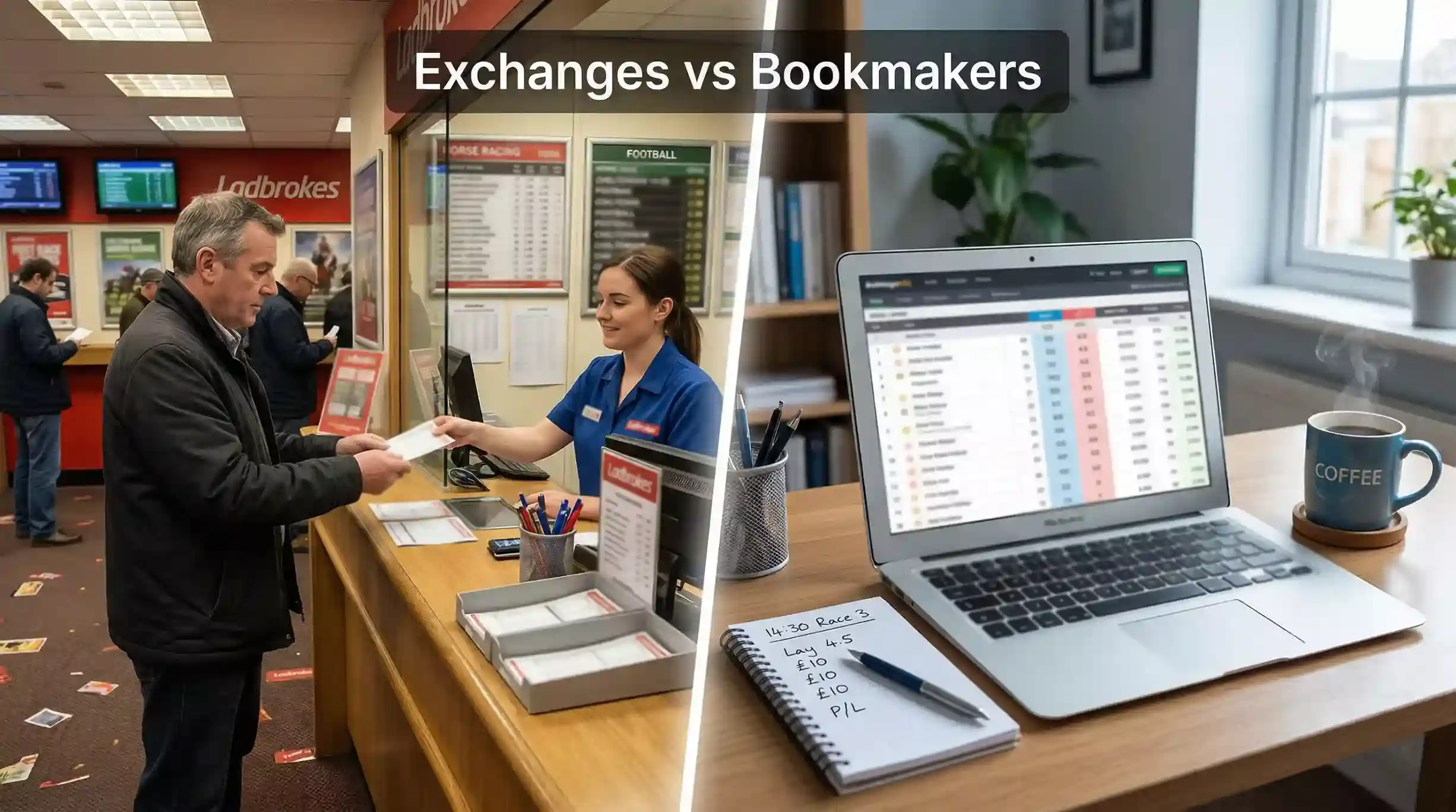
Betting exchanges and traditional bookmakers offer fundamentally different propositions. With a bookmaker, you bet against the house. The bookmaker sets the odds, accepts your stake, and pays out if you win. With an exchange, you bet against other punters. The exchange merely facilitates the transaction, taking a commission on winning bets. This distinction shapes everything from the prices available to the strategies that work.
The Gambling Commission’s Industry Statistics report that remote betting on horse racing generated £766.7 million in gross gaming yield during the 2024-25 financial year. That figure encompasses both exchange and fixed-odds betting, though traditional bookmakers still command the larger share. The exchange model, pioneered by Betfair in 2000, has matured into a genuine alternative rather than a niche product.
“For the fourth year running, contributions have increased to record levels,” noted Grainne Hurst, CEO of the Betting and Gaming Council, commenting on the betting industry’s support for racing. “This demonstrates the growing, long-term investment regulated betting provides British horse racing. But it is concerning to see once more despite record levy contributions, racing continues to struggle, both as a sport and as a betting product, with betting turnover down again year-on-year.” That tension between industry health and betting volume affects both exchanges and bookmakers, though in different ways.
The rise of exchanges challenged the traditional bookmaker monopoly on odds-setting. Before exchanges, punters accepted whatever price the bookmaker offered or did not bet. Exchanges introduced price competition, forcing bookmakers to sharpen their odds to remain attractive. Even punters who never use exchanges benefit from this competitive pressure.
This guide examines how exchanges function, explains the mechanics of lay betting that exchanges uniquely offer, and compares the cost structures of both platforms. Understanding these differences allows you to choose the right platform for each bet, potentially using both in combination for optimal results.
Exchange Betting Fundamentals
How Exchanges Work
A betting exchange is a marketplace where punters bet against each other. When you want to back a horse at 5.0, your bet is matched with someone willing to lay that horse at 5.0. The exchange displays available prices and volumes, showing what others are prepared to offer. If no one has offered to lay at your desired price, you can request it and wait for someone to match, or accept a price already available in the market.
The exchange takes no position on race outcomes. Unlike a bookmaker, which profits when punters lose, the exchange earns commission on net winnings regardless of results. This neutrality means exchanges have no incentive to limit successful bettors, a significant advantage for anyone who wins consistently enough to face restrictions elsewhere.
According to Houlihan Lokey’s European Online Gaming Market Report, UK online gross gaming yield reached over £5.5 billion in 2024, representing growth of approximately 12.3% year-on-year. Exchanges capture a meaningful portion of this market, particularly among sophisticated bettors who value the better prices and strategic flexibility exchanges provide.
Back vs Lay Explained
Backing a horse means betting it will win, the same as a traditional bet with a bookmaker. Laying a horse means betting it will not win, effectively taking the bookmaker’s side of the wager. Every exchange transaction requires both a backer and a layer. When you back, someone else lays. When you lay, someone else backs.
The ability to lay opens possibilities unavailable with traditional bookmakers. You can profit from horses you expect to lose, not just those you expect to win. You can also trade positions, backing at one price and laying at another to guarantee profit regardless of outcome. These capabilities transform betting from simple prediction into something closer to financial trading.
Lay betting carries different risk characteristics than backing. When you back a horse at 5.0 for £10, you risk £10 to win £40. When you lay the same horse, you risk £40 to win £10. The asymmetry reflects the probability: the layer wins more often but wins less each time. Understanding this relationship is essential before placing any lay bet.
Understanding Liquidity
Liquidity refers to the volume of money available to match at current prices. A liquid market has substantial amounts offered at tight spreads, making it easy to get matched at reasonable prices. An illiquid market has sparse offerings at wide spreads, forcing you to accept worse prices or wait longer for matches.
Horse racing liquidity varies enormously by race. Major handicaps and Group races attract significant exchange activity, with thousands of pounds available at each price point. Maiden races at minor meetings might have just a few hundred pounds in the market, making it difficult to place meaningful stakes without moving the price against yourself.
Pre-race liquidity typically exceeds in-play liquidity. Markets build depth in the hours before a race as punters position themselves. Once the race starts, liquidity thins as some participants withdraw and matching becomes faster and more volatile. Planning your exchange activity around these liquidity patterns improves execution quality.
Lay Betting Explained
What is Laying a Horse
When you lay a horse, you are betting it will not win. You take on the role of the bookmaker for that specific bet, accepting someone else’s stake and agreeing to pay out if the horse wins. Your profit is the backer’s stake if the horse loses. Your loss is the backer’s potential winnings if the horse wins.
The appeal of lay betting stems from the mathematical reality that most horses lose. In any race with ten runners, nine will not win. By laying selectively, you can profit from this statistical fact. The challenge lies in identifying horses whose true chance of winning is lower than the market implies, meaning the price at which you lay offers value.
Research from the National Centre for Social Research found that the top 1% of horse racing bettors, approximately 60,000 people, generate 52% of betting revenue. Many of these sophisticated punters use lay betting as part of their strategy, either to oppose overbet favourites or to trade positions opened with back bets. The concentration of revenue among skilled bettors suggests that edges exist for those who develop genuine expertise.
Calculating Liability
Liability is the amount you stand to lose if the horse wins. It equals the backer’s stake multiplied by the odds minus one. If you lay a horse at 4.0 for a £10 stake, your liability is £10 × (4.0 – 1) = £30. You must have that £30 available in your exchange account before the bet can be accepted.
The liability calculation explains why laying short-priced horses appeals to many punters. Laying at 2.0 means your liability equals the backer’s stake. Laying at 1.5 means your liability is only half the backer’s stake. The lower the odds, the less you risk relative to your potential profit. But short-priced horses win more often, so lower liability per bet does not necessarily mean lower overall risk.
Managing liability across multiple lays requires careful attention. If you lay several horses in the same race, your total liability is the worst-case outcome, which is the liability on the horse that wins. You cannot lose more than the liability on one horse, since only one can win. But if you lay horses across different races, liabilities accumulate independently.
Lay Betting Scenarios
Opposing short-priced favourites represents the classic lay betting scenario. When a favourite is priced at 2.0 but you assess its true chance at 40% rather than 50%, laying offers value. The market is overestimating the horse. If your assessment is correct over many bets, you profit despite the favourite winning reasonably often.
Laying horses with negative form indicators provides another angle. A horse returning from injury, stepping up sharply in class, or switching to unsuitable ground might be vulnerable despite reasonable market support. These horses often attract backing from casual punters who focus on names rather than conditions, creating lay opportunities for those who analyse the details.
Laying for trading purposes differs from laying as a standalone bet. Here, you lay first at shorter odds with the intention of backing later at longer odds when the price drifts. If the horse’s price moves from 3.0 to 4.0, you can back at 4.0 to lock in profit regardless of result. This approach requires the price to move in your predicted direction, which is not guaranteed.
Trading Strategies on Exchanges
Scalping Explained
Scalping involves capturing small price movements repeatedly. A scalper might back at 3.0 and lay at 2.98, or vice versa, taking a tiny profit on each completed trade. The profit per trade is minimal, perhaps a few pence per pound staked, but consistent execution across hundreds of trades accumulates meaningful returns.
Successful scalping requires liquid markets and fast execution. You need sufficient volume at adjacent price points to enter and exit positions quickly. Major races provide the liquidity; smaller races typically do not. Software tools help scalpers manage positions and react to market movements faster than manual trading allows.
The Horserace Betting Levy Board’s Annual Report noted that average turnover per race fell by approximately 8% in 2024-25 compared to 2023-24. Reduced turnover affects scalping opportunities by thinning liquidity, making it harder to execute trades at desired prices. Scalpers must adapt to changing market conditions or focus on the diminishing pool of highly liquid markets.
Swing Trading Races
Swing trading captures larger price movements over longer timeframes. Rather than seeking two-tick profits, swing traders aim for moves of 10%, 20%, or more. A horse backed at 5.0 and later laid at 4.0 yields substantial profit if the trade executes successfully. The timeframe might be hours rather than seconds.
News and information drive swing trading opportunities. When positive news emerges about a horse, perhaps a trainer’s optimistic interview or confirmation of preferred ground, the price typically shortens. Positioning before the news becomes widely known allows you to profit as the market adjusts. Conversely, negative news creates laying opportunities.
Swing trading requires genuine edge in information processing. The market incorporates public information quickly. To profit consistently, you need either faster access to information or better interpretation of available data. Many casual punters attempt swing trading without this edge, resulting in random outcomes that trend negative after commission.
In-Play Trading
In-play trading applies exchange strategies during races. Prices move dramatically as positions change and the finish approaches. A horse travelling well at odds of 6.0 pre-race might trade at 2.0 turning for home. Capturing that movement requires both race-reading skill and rapid execution.
The volatility of in-play markets creates opportunities but also risks. Prices can move several ticks between deciding to trade and your bet being accepted. Bet delays on exchanges, typically several seconds during in-play, mean the price you see is not necessarily the price you get. Managing this latency is essential for in-play trading success.
Green-up is the in-play trader’s goal: a position that profits regardless of outcome. If you backed pre-race at 5.0 and can lay in-play at 3.0, you can distribute your profit across all outcomes or let your position ride with guaranteed minimum return. Achieving green-up consistently requires reading races accurately and executing trades before the market fully adjusts.
Commission and Margins Compared
Exchange Commission Rates
Exchanges charge commission on net winnings rather than on stakes. Betfair’s standard commission rate is 5% for most users, though this can reduce to 2% or lower for high-volume traders through loyalty programmes. Smarkets offers a flat 2% commission. Other exchanges position between these points.
Commission applies only to winning markets. If you win £100 on one race and lose £100 on another, you pay commission only on the £100 win. This net calculation favours active traders who have offsetting positions. A pure backer who wins occasionally pays commission on those wins; a trader who frequently greens up pays commission on the net profit of each market.
The Gambling Commission reported that the number of betting premises has declined for the eleventh consecutive reporting period, falling 1.8% to 5,825 shops. This shift toward online betting benefits exchanges, which exist only online. As retail betting shrinks, the pool of punters familiar with exchange mechanics grows, though traditional bookmaker apps still dominate the online market.
Bookmaker Overround
Bookmakers build their profit into the odds through overround, also called the vig or juice. If a true market would sum to 100%, a bookmaker might offer odds summing to 110% or more. That 10% represents the bookmaker’s theoretical edge, though actual margins vary by market and competition.
Horse racing overrounds typically range from 110% to 130%, depending on the race and bookmaker. Competitive handicaps with many runners tend toward higher overrounds because each additional runner adds margin. Short fields, particularly in Group races, often carry lower overrounds as bookmakers compete for business.
Best Odds Guaranteed promotions complicate the overround calculation. When a bookmaker offers BOG, they accept the risk that Starting Price exceeds the price you took. This effectively reduces their margin on horses that drift, though they retain full margin on horses that shorten. BOG makes early price betting more attractive even at nominally higher overrounds.
True Cost Comparison
Comparing exchange commission to bookmaker overround requires examining specific scenarios. At 5% commission, an exchange offers better value than a bookmaker with 5% or higher overround, which includes most markets. But promotions, bonuses, and best odds guaranteed can shift the calculation.
The breakeven point for casual backers favours exchanges in most cases. If you back 100 horses at average odds of 5.0, winning 20% of bets as expected, exchange commission costs less than typical bookmaker overround. The advantage increases at longer odds, where bookmaker margins tend to be higher.
For lay bettors, exchanges are the only option since traditional bookmakers do not accept lay bets. The comparison becomes irrelevant; exchanges offer capability that bookmakers cannot match. This monopoly on lay betting is a significant exchange advantage for punters who want that strategic flexibility.
When to Use Each Platform
Scenarios Favouring Exchanges
Exchanges excel when you want the best price. In liquid markets, exchange odds typically beat bookmaker prices because there is no built-in margin. If multiple bookmakers offer 4.0 on a horse, the exchange might show 4.2 or 4.4 available to back. That price advantage compounds over thousands of bets.
Laying and trading require exchanges by definition. No traditional bookmaker lets you bet against horses or trade in and out of positions. If your strategy involves opposing favourites, hedging positions, or capturing price movements, exchanges are your only option.
Winning punters often migrate to exchanges after facing bookmaker restrictions. When a bookmaker limits your stakes or closes your account, exchanges remain open. The commission model means exchanges profit from your activity regardless of whether you win or lose, removing the incentive to restrict successful bettors.
When Bookmakers Win
Bookmakers offer promotions that exchanges cannot match. Welcome bonuses, free bets, enhanced odds, and money-back specials add value beyond the raw odds. A horse at 5.0 with a bookmaker becomes effectively better than 6.0 on an exchange when accompanied by a free bet promotion. Promotional exploitation is a legitimate strategy that requires bookmaker accounts.
Best Odds Guaranteed provides genuine value for early price bets. If you take 5.0 in the morning and the Starting Price is 8.0, the bookmaker pays at 8.0. Exchanges offer no equivalent protection. For punters who bet early and benefit from price drifts, BOG can outweigh the typical exchange price advantage.
Illiquid markets favour bookmakers. When an exchange shows only £50 available at your desired price, you cannot place a meaningful stake without accepting worse odds. Bookmakers, by contrast, typically offer reasonable stakes even on minor races. If you regularly bet on smaller meetings, bookmaker liquidity may prove more practical than exchange liquidity.
Hybrid Approach
Sophisticated punters use both platforms strategically. They compare prices before each bet, backing with whichever offers better value. They use bookmakers for promotions and exchanges for pure price-seeking. They maintain accounts with multiple operators to maximise options.
Arbitrage between platforms is theoretically possible but practically difficult. If a bookmaker offers 5.0 while an exchange allows laying at 4.8, you can back with the bookmaker and lay on the exchange for guaranteed profit. Such opportunities are rare, short-lived, and often accompanied by terms that complicate execution. Most punters find the effort exceeds the reward.
The hybrid approach extends to individual bets. You might back with a bookmaker at a promotional price, then lay on the exchange to reduce or eliminate variance while retaining the promotional value. This technique, known as matched betting when done systematically, exploits the gap between promotional and market prices.
See also Bankroll Management for Horse Racing.
Choosing Your Platform
Exchanges and bookmakers serve different purposes and suit different strategies. Neither is categorically better. The right choice depends on what you are trying to achieve with each specific bet. Understanding both platforms allows you to select the optimal venue for each wager rather than defaulting to habit.
If you are new to betting, start with bookmakers. The interface is simpler, promotions provide initial value, and you avoid the complexity of liability calculation and liquidity assessment. As you develop sophistication, add an exchange account to access better prices and new strategic possibilities. Most successful punters eventually use both.
Lay betting and trading represent genuine edges for those who master them. The ability to profit from horses losing, not just winning, doubles the opportunity set. The ability to lock in profit mid-race through trading adds a dimension that pure backing cannot match. These capabilities justify the learning curve exchanges require.
The market continues to evolve. Commission rates shift as exchanges compete for users. Bookmaker restrictions tighten as analytics identify winning punters faster. Regulatory changes affect both platforms in ways that remain difficult to predict. Staying informed about these developments helps you adapt your platform strategy as conditions change.
Ultimately, platforms are tools. What matters is finding value: identifying bets where your assessment of probability exceeds the market’s. Whether you find that value with a bookmaker or an exchange is secondary. The platform that offers the best price for your selected bet is the platform you should use, which is why maintaining accounts with both remains the professional approach. Betting Exchanges vs Bookmakers for Horse Racing UK — More on this topic at live horse racing betting.
